Banking CRM · Built by bankers, for banks only

A controlled client-relationship workspace, built for banks.

Not a generic CRM adapted for banking — a banking operating layer. Varnix sits on top of your core banking system and orchestrates the next customer action, instead of asking you to replace what already works.

Watch the walkthrough
V Dashboard Demo environment
Bank CRM dashboard showing active client base, cross-sell ratio, NBO response rate and SLA metrics

See it in action

Watch a Banking CRM walkthrough

A walk through Customer 360, the approvals engine and reporting dashboards, in a real demo environment. Placeholder below; drop in the real recording once it's ready.

Video placeholder
Banking CRM walkthrough — 4 minutesReplace this frame with a real walkthrough recording when ready.

Why we're different

We didn't guess what a bank needs. We used to run one.

Most CRM vendors learn banking from an RFP. Our team learned it in the branch, the credit committee and the compliance review — before a line of code was written. Every feature below traces back to a specific place that experience showed up in the product.

We've sat in credit committee meetings.
That's why approvals carry delegation and SLA escalation by default — a stuck price exception is a business problem, not a workflow edge case.
We've run branch and call-center KPIs.
That's why dashboards are role-based from day one — a branch manager and a head of retail shouldn't read the same report to find different answers.
We've filled out AML and KYC questionnaires ourselves.
That's why audit trail and role boundaries were architecture decisions, not features added after a regulator asked.
We've watched "configurable" CRM become a year-long project.
That's why the platform ships with a banking org structure, segments and roles out of the box — configuration per market, not a rebuild.

"Built by bankers, for banks only" isn't a slogan we bought — it's why the roadmap below is organized around what a bank's operating day actually looks like, branch to boardroom.

The problem with generic CRM

Why generic CRM fails in banking

Customer data stays siloed

Branch, contact center, mobile and internet banking each see a different slice of the same client.

Compliance is an afterthought

Bolted-on modules can't carry an audit trail or an approval chain a regulator will accept.

Endless customization

Generic platforms turn every new segment or product into a multi-month configuration project.

Omnichannel

Every channel, one client record

Today, most banks' channels don't talk to each other — a branch visit, a call-center ticket and a mobile-banking session about the same client live in three different systems with no shared view. Customer 360 is built to be the layer that unifies them.

Without a shared view

Branch Contact Center Mobile Banking Internet Banking × × ×

With Varnix

Branch Contact Center Mobile Banking Internet Banking Customer 360
Full omnichannel interaction history — contact center, IVR, mobile/internet banking sessions feeding automatically into Customer 360 — is on the roadmap (Stage 8), not shipped today. The branch and manual-entry path into Customer 360 is live now.

Module catalogue

One platform, sixteen modules

The full module catalogue from our banking technical specification, organized the way a bank's operating model is organized — branch to boardroom, not feature-list order.

01

Customer 360 / MDM

Single client profile across individuals, companies and groups.

02

Sales & Lead Management

Segment funnels, lead capture, manual client creation with dedup.

03

Service & Case Management

Omnichannel interaction history, case routing, SLA.

04

Complaints Management

Regulatory deadline tracking, escalation, root-cause analytics.

05

Corporate Sales / RM Workbench

Counterparty cards, group hierarchy, RM visit calendar.

06

Private Banking / VIP

Extended profile, household wealth view, concierge offers.

07

Scoring & Risk Profiling

Credit-registry integration, score cards in the CRM record.

08

AML / KYC / Compliance

Risk-based KYC, sanctions/PEP screening, regulator reporting.

09

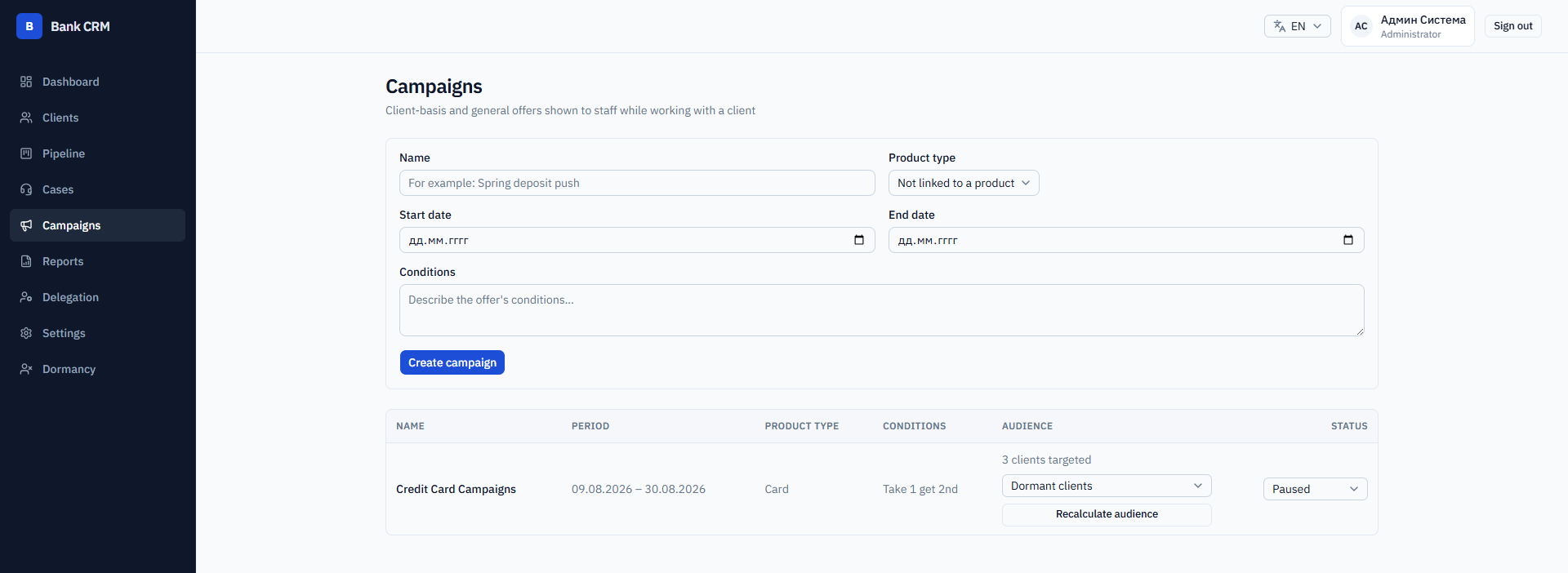
Marketing & Campaigns

Segmentation, trigger campaigns, multichannel push/SMS/email.

10

Document Workflow & E-Signature

Templated documents, e-signature, versioned archive.

11

Approvals & Workflow (BPM-lite)

Approval routes, delegation, SLA escalation, price exceptions.

12

BI & Reporting

Role-based dashboards, drill-down, scheduled export.

13

Administration & Access Control

RBAC/ABAC, audit log, low-code business rules.

14

Integration Layer / API Gateway

OpenAPI contracts, connectors to core systems.

15

Mobile Workplace

Offline-capable client for relationship managers.

16

AI Assistant

Case summarization, real-time next-best-action.

Beyond this core catalogue, our discovery process draws on a broader menu of 60+ configurable retail modules and 20 corporate modules, built from real scoping conversations with banks across the region.
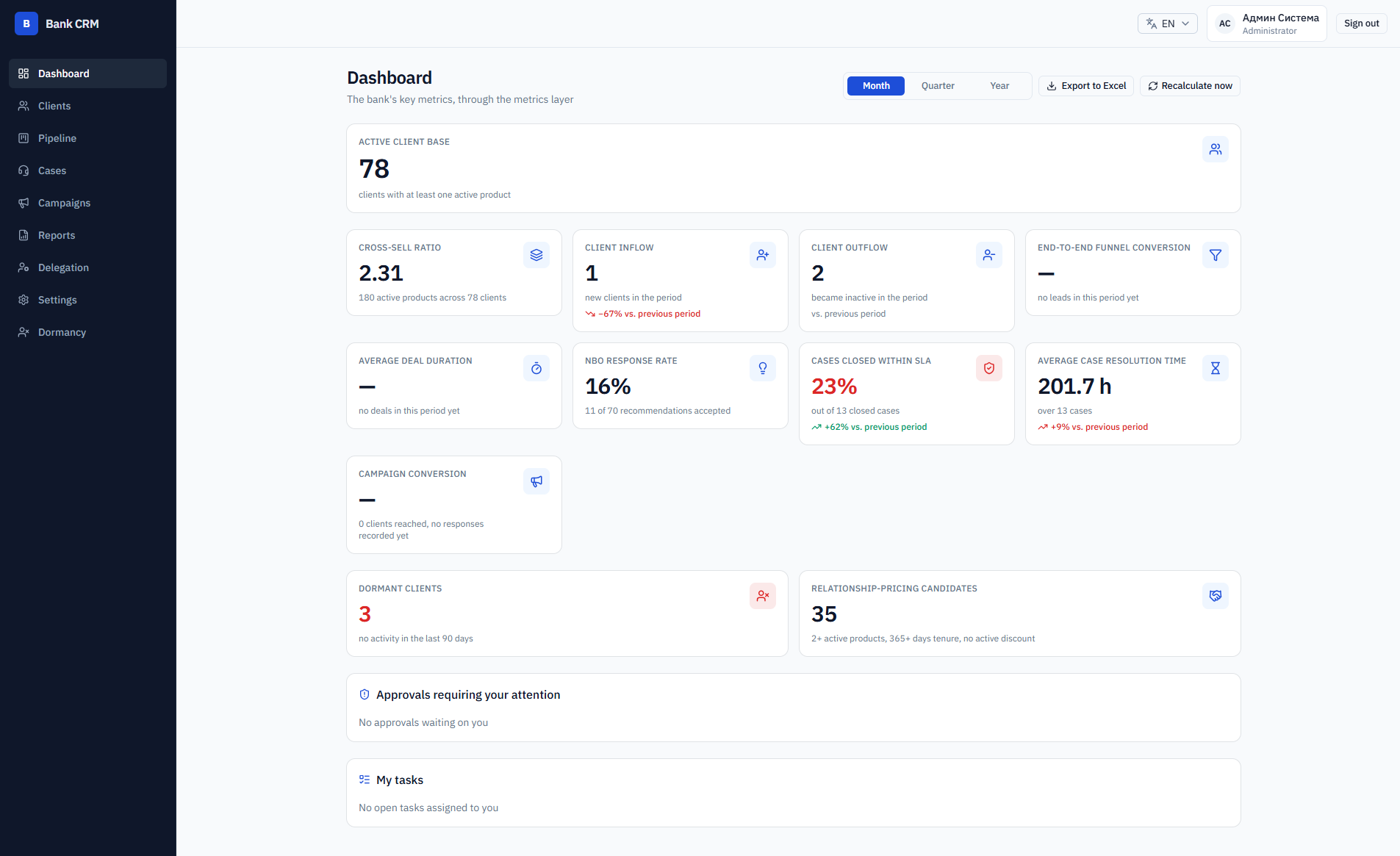
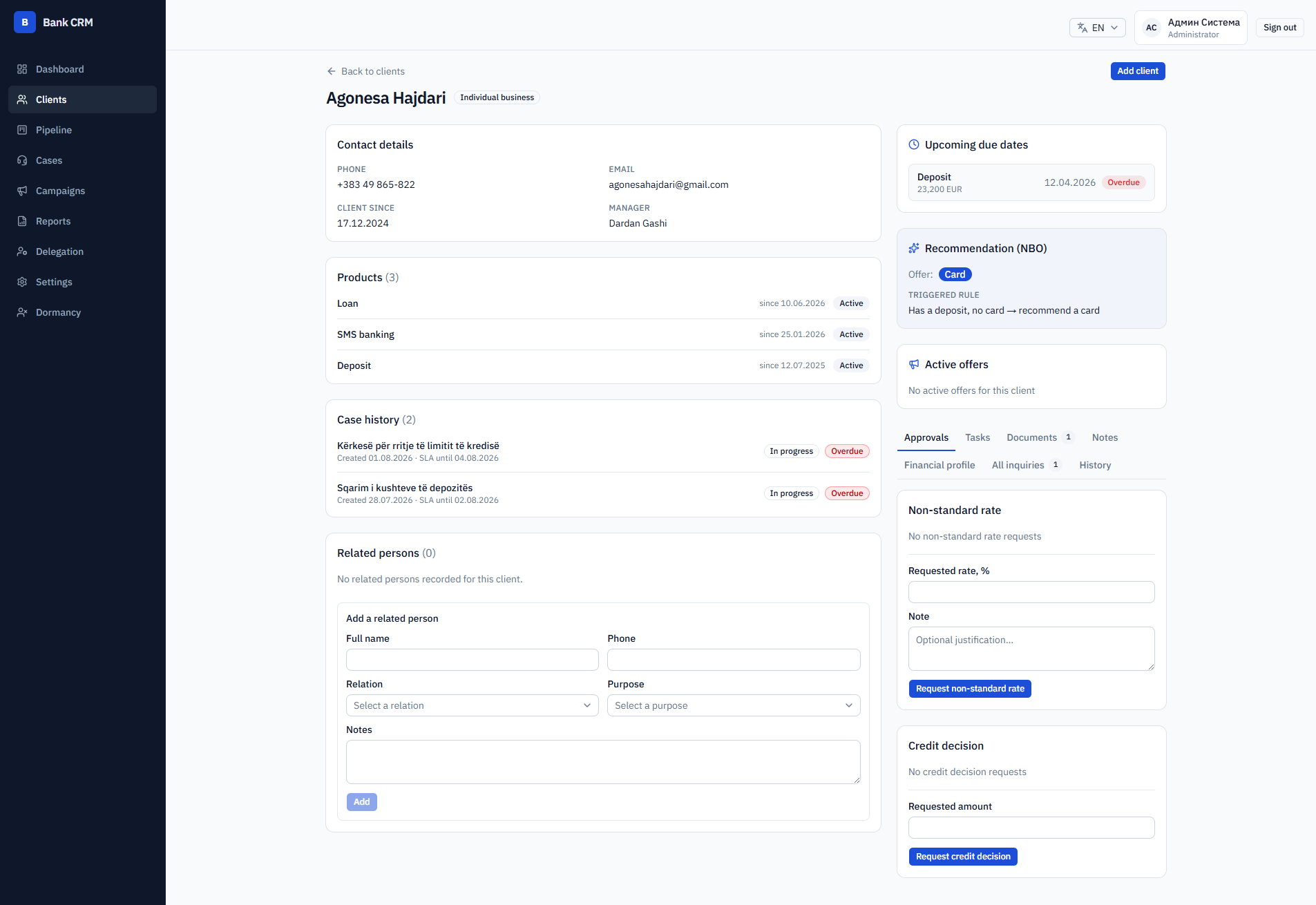
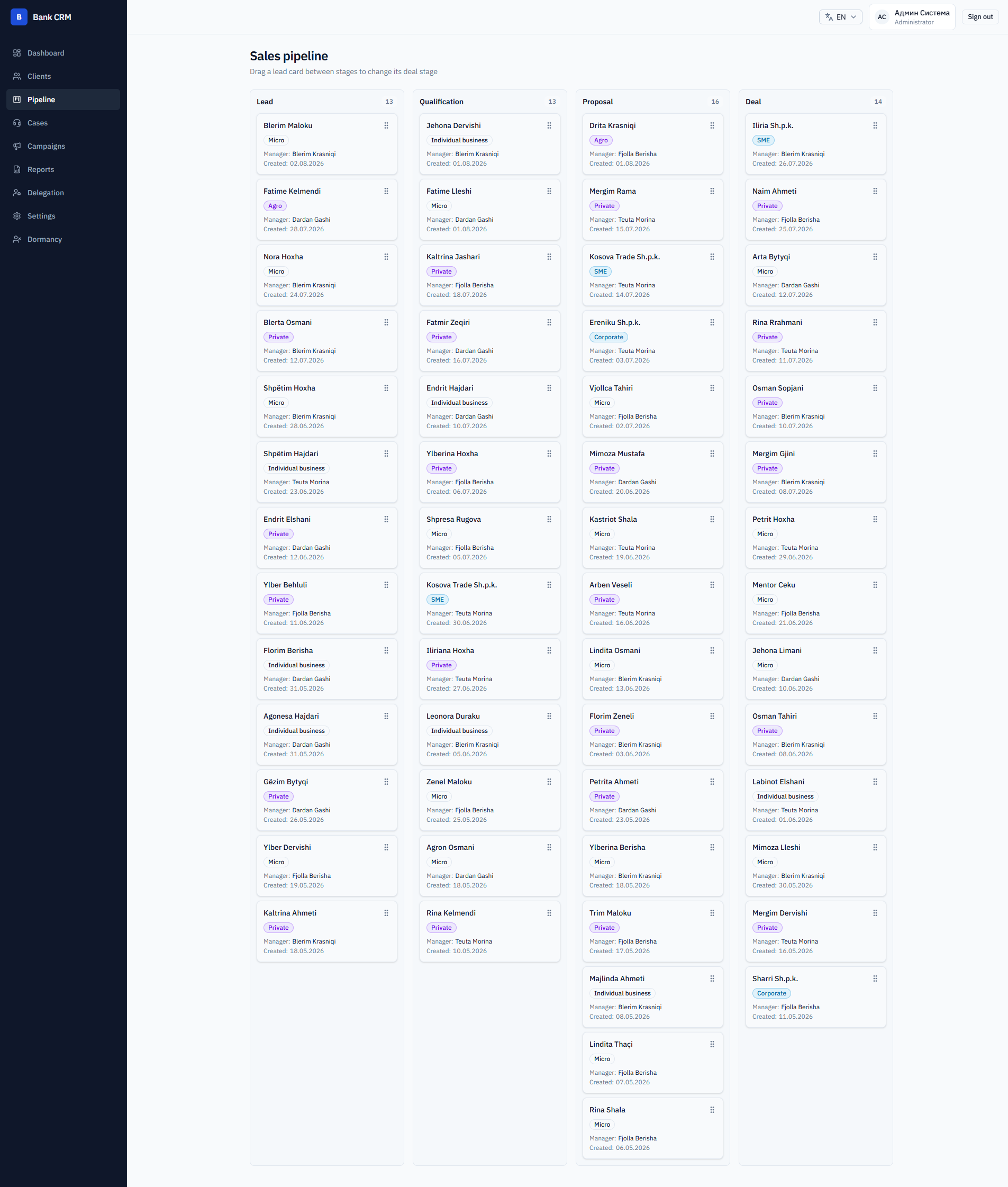
See it for yourself

From our demo environment, not a slide deck

A few screens from the running demo, matched to the modules above.

Architecture

Fits into what you already run

Varnix is a modular monolith today — one deployable, with module boundaries enforced by lint rules — that talks to the rest of your banking stack through a single API gateway, instead of every module wiring itself directly into your systems.

SINGLE DEPLOYABLE Varnix Banking CRM Customer Sales Service Approvals Analytics Identity API Gateway internal calls Core Banking Credit Registry Payment Rails Antifraud & DWH
Today, the gateway issues and validates API tokens; the connector set to core banking, credit registries, payment rails and antifraud platforms is Stage 4 on the roadmap, not shipped. The module boundaries inside the monolith are real and enforced now.
8bounded modules
3interface languages
2demo markets
1shared codebase

Deployment

Architecture that fits how a bank actually buys software

Deployment choice

Cloud (single-tenant) or on-premise, including an air-gapped option, from one codebase — not a fork per client.

Modular monolith, by design

Strict module boundaries enforced by lint rules — a deliberate middle step before a future microservices target, not an unstructured legacy app.

Graceful degradation

Designed so the CRM stays usable even when a source system — core banking, scoring — is temporarily unavailable.

Country configuration, not a fork

Segments, ID validation, locale and reference data are configuration per market, so one platform serves different regulatory environments.

Security

Security built for a bank's sign-off process

Role- and attribute-based access control
Full audit trailEvery record change and approval step is logged.
Designed against regional regulationRegional banking-security, AML/CFT and personal-data frameworks considered from the technical spec stage.
On-premise / air-gapped deploymentAvailable for banks that require it.

Certification status (PCI DSS, penetration testing, LDAP/AD SSO) is roadmap, not current — ask us for the up-to-date status during evaluation.

Markets

Built for Southeast Europe and the Caucasus

Varnix Banking CRM is shaped around markets where regulation, language and core-banking integration are as important as the CRM features themselves — currently in active discovery and pilot conversations with banks in Kosovo and across the Balkans, with Azerbaijan as a core regulatory design target.

Kosovo Balkans Azerbaijan The Caucasus

What to expect

What banking CRM programmes typically deliver

Industry benchmarks from published banking-CRM programmes — illustrative, not a Varnix commitment or a measured result from our own deployments.

+25%Cross-sell revenue
+30%Lead conversion
−40%Case handling time
−60%Report preparation time

Sources: aggregated public case studies of CRM programmes in retail and universal banks. Your results depend on your starting point, data quality and adoption — ask us for the assumptions behind each figure.

Let's talk about your next customer process,
not a software demo.

Full video tour coming soon